
Six Reasons Why Brussels is an Underrated Destination
One of the first solo trips I planned was to Brussels, Bruges, and Amsterdam. Whenever I told people where I was going, I was often met by a puzzled expression and the question “Why Brussels?” Bruges and Amsterdam are always popular, but Brussels?
There were several reasons why Brussels was high on my list - the waffles, the chocolate, the opportunity to practice my French. But I wasn’t expecting to fall in love with the city the way that I did. From the second I stepped off the train at the Brussels-Central/Centraal station to bright sunlight and a bustling market, to the day I left with a suitcase full of chocolate, I realized there’s so much this small city has to offer. Here are a few reasons why you might want to add it to your travel wish list.
1. Brussels is rich with history, beauty, and culture.
From the Grand Place, its beautiful square surrounded by guildhalls, to the Royal Quarter, to the headquarters of the European Union, the history of Brussels spans centuries. Take your time wandering through the cobblestone streets of the lower town, stopping at the Grand Place to marvel at the Town Hall, a building Victor Hugo described as “a dazzling poet's fantasy that fell from the head of an architect.” Head to the upper town for a break in Brussels Park or to explore the museums of the Royal Quarter. Don’t miss the European quarter, where you can tour the European Parliament’s hemicycle and learn more about the European Union. Finish with a visit to the nearby Cinquantenaire, a park and arch built in 1880 to celebrate the country’s 50th birthday.
🏛️ Recommended sites:
Royal Museums of Fine Arts of Belgium: Manageable collection of art museums including the Old Masters and Magritte Museums. For those of you like me who have been fascinated by the French Revolution since you were a teenager (is it just me?), you can see Jaques-Louis David’s famous painting, The Death of Marat.
European Parliament Hemicycle: Please note that you may need to show your passport and will need to go through security to visit the hemicycle.
📚 Recommended reading:
King Leopold’s Ghost by Adam Hochschild: This gripping nonfiction book tells the story of King Leopold II of Belgium’s brutal exploitation of the Congo, the spoils of which were used to build much of the Royal Quarter that you see today.
2. Brussels is the comics center of the world.
Did you know that Tintin and the Smurfs are Belgian? Wander around and see the famous comic murals throughout the city, or visit the Comics Art Museum to learn more about the history of comics.
🏛️ Recommended sites:
Comics Art Museum: Learn more about the history of comics and marvel at this beautiful Art Nouveau building designed by Victor Horta. There is also an impressive bookstore where you can find all kinds of comic books.
Murals: See how many murals you can find, including Tintin near the Grand Place and the Smurfs by the central train station.
📚 Recommended reading:
The Adventures of Tintin by Hergé
The Smurfs books by Peyo
3. You can walk in the Brontës’ footsteps.
In 1842, Charlotte and Emily Brontë came to Brussels to improve their French and German. Their time studying in Brussels inspired their writing, especially Charlotte’s. For lovers of their writing, a visit to Brussels gives a glimpse into some of the settings that inspired their work.
🏛️ Recommended sites:
While Brussels looks different today than it did in the Brontës’ time, the Brussels Brontë Group organizes tours that allow you to follow in Charlotte and Emily’s footsteps.
📚 Recommended reading:
Villette by Charlotte Brontë: This novel follows Lucy Snowe as she travels from England to the fictional city of Villette (based on Brussels) to find work in a girls’ school similar to the one Charlotte and Emily attended. Personally, I like this one better than Jane Eyre!
The Brontës In Brussels by Helen MacEwan: Learn more about Charlotte and Emily’s time in Brussels, the school they attended, and what Brussels would have looked like in their time.
4. Brussels is a small, walkable city.
I went to Brussels as the first stop of my first trip to Europe as a solo traveler. Its small size and walkability were a big part of the reason I chose it. It’s not overwhelming, the way London or Paris might be for a first-time solo traveler. Brussels consists of a lower town, where the Grand Place is located, and an upper town, where the Royal Quarter is found, with the central train station in between. Wandering around by myself felt easy and safe. For sights that were a bit farther from this central area (like the European Quarter and Cinquantenaire), hop-on hop-off buses provide a scenic route and interesting narration. Brussels is also only a short train ride from other Belgian destinations, such as Bruges, Ghent, or Antwerp; a less than two hour train ride from Amsterdam; and a less than one and a half hour train ride from Paris.
5. You can take a day trip to Waterloo for even more history.
The historic battlefield where Wellington defeated Napoleon is only a short train and bus ride from Brussels. Visit the wonderful museum underneath the battlefield to learn more about Napoleon, his return from exile, and his defeat at Waterloo, then climb the 226 steps to the top of the Lion’s Mound for a view of the battlefield.
🏛️ Recommended sites:
Memorial Museum: While a car is helpful to see some of the historic sights, it is not necessary to visit the museum and Lion’s Mound.
📚 Recommended reading:
War and Peace by Leo Tolstoy: This epic story follows several Russian families throughout the Napoleonic Wars. While it ends before the Battle of Waterloo, it gave me a greater appreciation for this period in history. It took me almost a year to read War and Peace, reading 5 pages a day and finishing around the time of my trip to Brussels!
Napoleon: A Life by Andrew Roberts: An interesting and readable biography of Napoleon.
6. And yes, the waffles and chocolate are amazing.
There are two types of waffles in Belgium: the Brussels waffle, which we call a Belgian waffle in the US, and the Liège waffle, which is denser and is made with pearl sugar that caramelizes as it cooks. Liège waffles are actually more popular in Belgium and can be purchased to-go for an afternoon snack. Waffles aren’t the only food Belgians are known for - the chocolate, fries (eaten with mayonnaise, not ketchup), mussels, and beer are also famous.
🍫 Recommended stops:
Los Churros and Waffle
Maison Dandoy
Chocolaterie Mary
Practicalities
Languages spoken: Brussels is bilingual and French and Dutch are the official languages. But almost everyone speaks some English.
Currency: Euro
When to go: I went at the beginning of September and it was perfect - long days, still warm, and no crowds. Like other destinations in Northern Europe, summer is the peak season, and April-May and September-October are shoulder seasons. The Belgian Beer Festival is usually the first weekend in September and takes place in Brussels’ Grand Place.
Have you been to Brussels before? Would you like to go? I’d love to hear your thoughts!
Interested in planning a trip to Belgium? Submit our Travel Inquiry Form today!
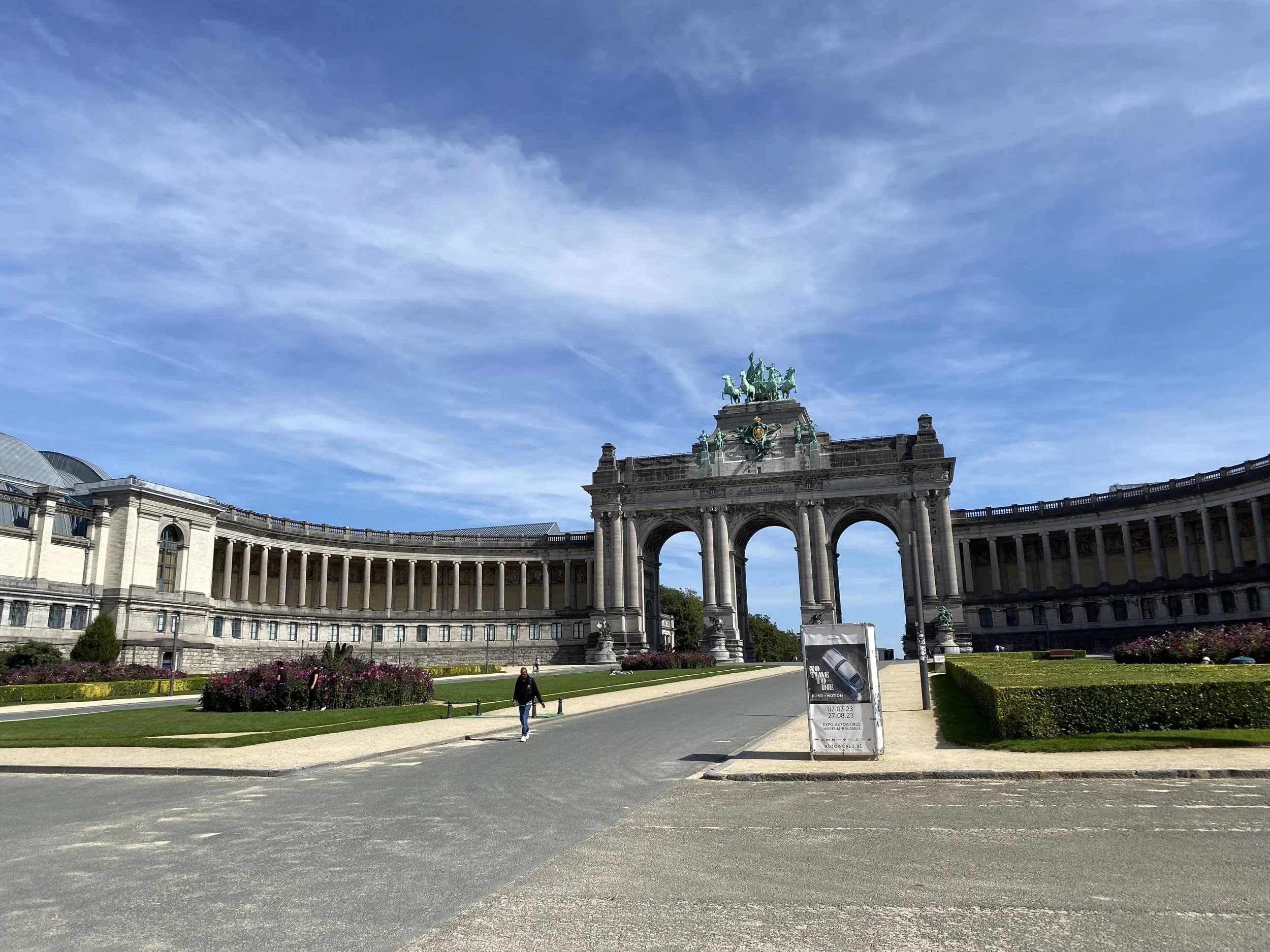
The Cinquantenaire arch in Brussels.